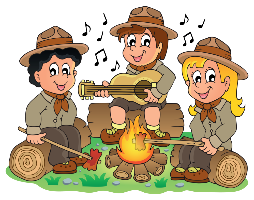
A campfire program is a gathering of Scouts, troop leaders, and family members for fun and fellowship. Despite its name, it doesn't necessarily have to occur at night or include an actual fire.
Campfire programs offer a unique platform for honing public speaking, creativity, and planning skills while preserving the tradition of oral history and storytelling.
Pro Tip - Communication Merit Badge: Planning a campfire program is a direct fit for requirement 8: plan a troop or crew campfire program, have the patrol leaders' council approve it, write the script, prepare the program, and serve as master of ceremonies (the Emcee, or "Master of the Fire"). Serving as Song-Master or Cheer-Master is great practice, but the requirement asks the Scout to do all of it. Check with your merit badge counselor before the campfire. See Hone Your Skills for more on how campfire leadership builds communication skills.
Campfire programs provide Scouts with a valuable opportunity to develop essential skills, fostering growth in public speaking, creativity, and organizational abilities.
Scouts and campfire programs are an enduring combination. Whether performing, assisting behind the scenes, or simply observing, campfire programs empower Scouts of all ages to engage, express themselves, and gain insights into their peers and themselves.
Campfire ceremonies reinforce Scouting principles of patriotism, citizenship, and duty to God. Respect is paramount during ceremonies, setting the tone through example and communication.
A successful campfire program includes four key elements:
An often-overlooked fifth key element is Cheers, Yells and Applauses, providing a fun way to acknowledge performances and encourage audience participation. The Master-Of-The-Campfire should list a few of these elements on the planning form to suggest ideas for celebrating acts.
Ideally, designate the leadership roles for the campfire program during the monthly PLC meeting. The roles might need to be set for a month out to give time for the Master-Of-The-Campfire to get sign-ups, plan the campfire, and then get approval from the PLC. Similar to duty rosters for cooking and cleaning, this should be a rotating duty.
These leadership roles can be fulfilled by one person, with the exception of the Keeper-Of-The-Flame, who needs to be focused on the fire.
During the campfire program itself may not be the best time to teach new elements. Sometimes it can't be avoided, such as at Parents' Night or Cub Scout visitation events.
Use the fire itself as a visual guide for pacing. High flames call for energetic songs and skits; as the fire burns lower, transition to slower songs and reflective moments.
The formal opening often coincides with the lighting of the campfire or a dramatic entrance by the leaders carrying candles or torches.
After opening, continue with well-known songs, rounds, action songs, games, skits, and yells, building excitement as the flames grow higher.
As the fire burns down, slow the program with calmer songs, thoughtful stories, and a short inspirational moment to close the evening.
Safe fire practices are essential. The Keeper-Of-The-Flame must be trained and certified, ideally holding the 'Firem'n Chit'.
Good ceremonial fire practices include:
Additional ceremonial fire guidance can be found at The Ceremonial Campfire.
Burn bans, bad weather, or local rules may sometimes prohibit fires-but don't cancel your campfire program!
Campouts often introduce Cubs to the outdoors for the first time. Use the opportunity to teach emergency preparedness:
Choosing the right song for each stage of the campfire program is crucial. Not only should the leader and audience be familiar with the song, but it must also be suitable in content, tempo, and age appropriateness.
Instrumental accompaniment-such as a guitar, ukulele, or even kazoos-enhances the experience. Practice with both the song leader and instrumentalists beforehand. A pitch pipe, while not required, can help find the starting note.
Skits should ideally last between 90 seconds and 3-5 minutes.
To aid in planning your campfire program, several printable PDF forms are available. Early on, the Master-Of-The-Campfire should solicit song, skit, and story requests from patrols (and adults).
Check each act for appropriateness and avoid duplication-some skits and songs are known by multiple titles.
If there are too many entries, the Master-Of-The-Campfire must select the best mix to fit the time available.
Assign leadership roles (Emcee, Song-Master, Cheer-Master, Keeper-Of-The-Flame) during the prior PLC meeting.
Prepare a list of cheers and yells for the Cheer-Master to use:
| Can Of Applause | Relay Cheer |
| Trail Boss Cheer | Round of Applause |
| Baseball Applause | Broken Trolley |
| Spot | Title | Leader | Length (min) |
|---|---|---|---|
| 1 | Campfire Opening #1 | Emcee | 1 |
| 2 | Fire Lighting | Emcee / Keeper-Of-The-Flame | 3 |
| 3 | Introductions | Emcee | 3 |
| 4 | Song: There Ain't No Bugs On Me | Song-Master | 3 |
| 5 | Skit: Big and Strong Like You | Bat Patrol | 3 |
| 6 | Applause (Choose one) | Cheer-Master | 2 |
| 7 | Run On: Let's Toss Jack (Part 1) | Robin Patrol | 2 |
| 8 | Song: Sponge Bob FUN Song | Song-Master | 2 |
| 9 | Story: The Cremation Of Sam McGee | Asst. Scoutmaster Smith | 4 |
| 10 | Round: Kookaburra Song | Song-Master | 4 |
| 11 | Run On: Let's Toss Jack (Part 2) | Robin Patrol | 2 |
| 12 | Song: Quartermaster's Store | Song-Master | 4 |
Once the program is finalized, distribute copies to all leaders involved, so everyone is prepared for a smooth event.
Here are some useful tools and references to help you plan a successful campfire program: